


Microsoft will retire Purview Data Governance, with support ending on 12 November 2027. Its replacement, governance in the Fabric OneLake catalog, is not there today. Our advice: prepare now, and evaluate the OneLake governance features as they roll out in 2027.
What Microsoft announced
On 12 November 2026 Microsoft announced the retirement of Purview Data Governance. Support ends on 12 November 2027. The retirement covers the Unified Catalog, the Data Map, Workflows and the classic Azure Purview solutions.
Six facts matter for anyone running Purview today:
- The catalog retires. Business glossary, data products, data quality, lineage and scanning all sit in the retiring part.
- Security and compliance stay. Sensitivity labels, DLP, Insider Risk Management and DSPM for AI remain in Purview. If you use Purview to protect data, nothing moves.
- Microsoft now leads with Fabric and the OneLake catalog. The governance features that replace Purview are not in the OneLake catalog today. Glossary, data products, data quality and lineage across sources are expected to roll out there during 2027.
- Purview Data Governance is frozen. Microsoft's documentation states that new accounts can no longer be created, and existing capabilities stay in maintenance mode until the end date (Microsoft Learn notice).
- No separate governance meters. Microsoft says governance in Fabric is included in Fabric capacity (announcement blog). If you hold no Fabric capacity today, you will need one.
- Other catalogs stay possible. Fabric exposes its metadata through public APIs, so an enterprise data catalog can read it and sit on top.
A year is short for a governance program with a filled glossary and integrations built on the Atlas API.
What we do not know yet
Microsoft announced an end date before publishing a feature-by-feature plan for Fabric. The announcement points to the general Fabric roadmap, and at the time of writing we found no public mapping of each Purview capability to its Fabric successor with a date. That leaves four open questions.
| Open question | Why it matters |
|---|---|
| Which features arrive when? | You can only plan a cutover once glossary, data products, data quality and lineage each have a date. |
| How well will external sources be supported? | Most estates include Databricks, Snowflake, SQL Server or SAP. Purview scanned those through the Data Map. In Fabric the route is shortcuts and mirroring, which bring the data or its metadata into OneLake. A source that cannot be mirrored or shortcut does not show up in the catalog. |
| Will there be a migration tool? | Glossary terms, governance domains, data products and data quality rules took months to build. Re-keying them by hand is expensive. Purview has an API to extract them. Microsoft's published guidance names no migration tool, so plan for a manual or scripted move. |
| What will it cost? | Microsoft says governance is included in Fabric capacity, with no separate meters. Scans and quality checks will still draw on the capacity your analytics workloads use, and Microsoft has not published how much the new features will consume. |
We expect answers as the features roll out during 2027.
A technical catalog or a business catalog
Our current reading: the OneLake catalog will be to Fabric what Unity Catalog is to Databricks. It sits inside the platform and serves the people who build on it.
That is good news for data engineers and analysts. They get discovery, lineage, endorsement and access in the tool they already work in, without a second portal.
Business users are a different audience. Nobody sends a finance controller or a sales manager into Unity Catalog to look up the definition of net revenue. They need a place that speaks their language: terms, owners, data products, a button to request access. Whether the OneLake catalog becomes that place is the question we would put first in any evaluation.
Today the OneLake catalog cannot replace Purview Data Governance. Most features are not there yet, and it covers discovery and (high-level) lineage inside Fabric. A business glossary and coverage of sources outside Fabric still have to arrive, and those are the parts most Purview customers rely on.
Our advice: evaluate the governance features as they roll out in 2027. Plan for a period in which Purview still holds your glossary while its successor is in preview.
What the OneLake catalog covers today
The table sets what you use in Purview against what the OneLake catalog does in November 2026, with what we would do about each line. The status follows a Microsoft Tech Community mapping of 13 November 2026; the grouping and the advice are ours.
| In Purview you use | In the OneLake catalog today | What we would do |
|---|---|---|
| Search, domains and ownership | Available for Fabric items: search and filters, Fabric domains, owners, endorsement | Map your governance domains to Fabric domains |
| Glossary and critical data elements | Tags and descriptions only | Prepare an export terms and owners, and keep them stored outside of Purview – you’ll need it |
| Data products | Domains, endorsement, sharing, discoverable semantic models | Keep the product definition, its owner and its access process outside the catalog for now (ODCS/ODP) |
| Lineage | Fabric lineage and impact analysis for supported items | Keep another method for lineage across platforms and at column level |
| Data quality | Freshness and curation signals, without rules, profiling or scores | Keep your current data quality tooling |
| Access requests and workflows | Request access on semantic models and item sharing | Leave approval processes where they run today |
| Scanning of external sources | Shortcuts and mirroring, without a metadata scanner | Check source by source whether it can come into OneLake |
One regional detail matters for our Belgian customers. Fabric Policies, the central policy feature, is in preview, and the same post lists West Europe and North Europe among the capacity regions where it is not yet supported.
Which path fits you
This is how we would approach the decision. We start from two things: whether you run Purview Data Governance today, and how much of your estate lives in Fabric. Two questions at the end weigh heaviest.

Every route that ends in OneLake passes the two highlighted questions. If your business users will not work in the OneLake catalog, or if you need advanced governance features such as approval workflows, stewardship tasks, policy management or custom metadata, you land on the same outcome as an estate that cannot move into OneLake: a platform catalog with an enterprise data catalog above it. You cannot answer the highlighted questions today. They wait for the governance features Microsoft releases in 2027.
The target picture
Most of our customers run more than one platform. Each platform brings its own catalog, and each of those catalogs does its technical job well. What is missing is one place above them for the business.

The OneLake catalog and Unity Catalog stay the source of technical metadata, lineage and access for their own platform. The enterprise data catalog harvests from both and adds what the business and your agents need: one glossary and one list of data products, each with an owner. Purview keeps doing data security underneath.
There is a simpler variant. If Fabric is your main consumption layer and your other platforms are supported sources for OneLake, you can go Fabric-first and let the OneLake catalog be the catalog.
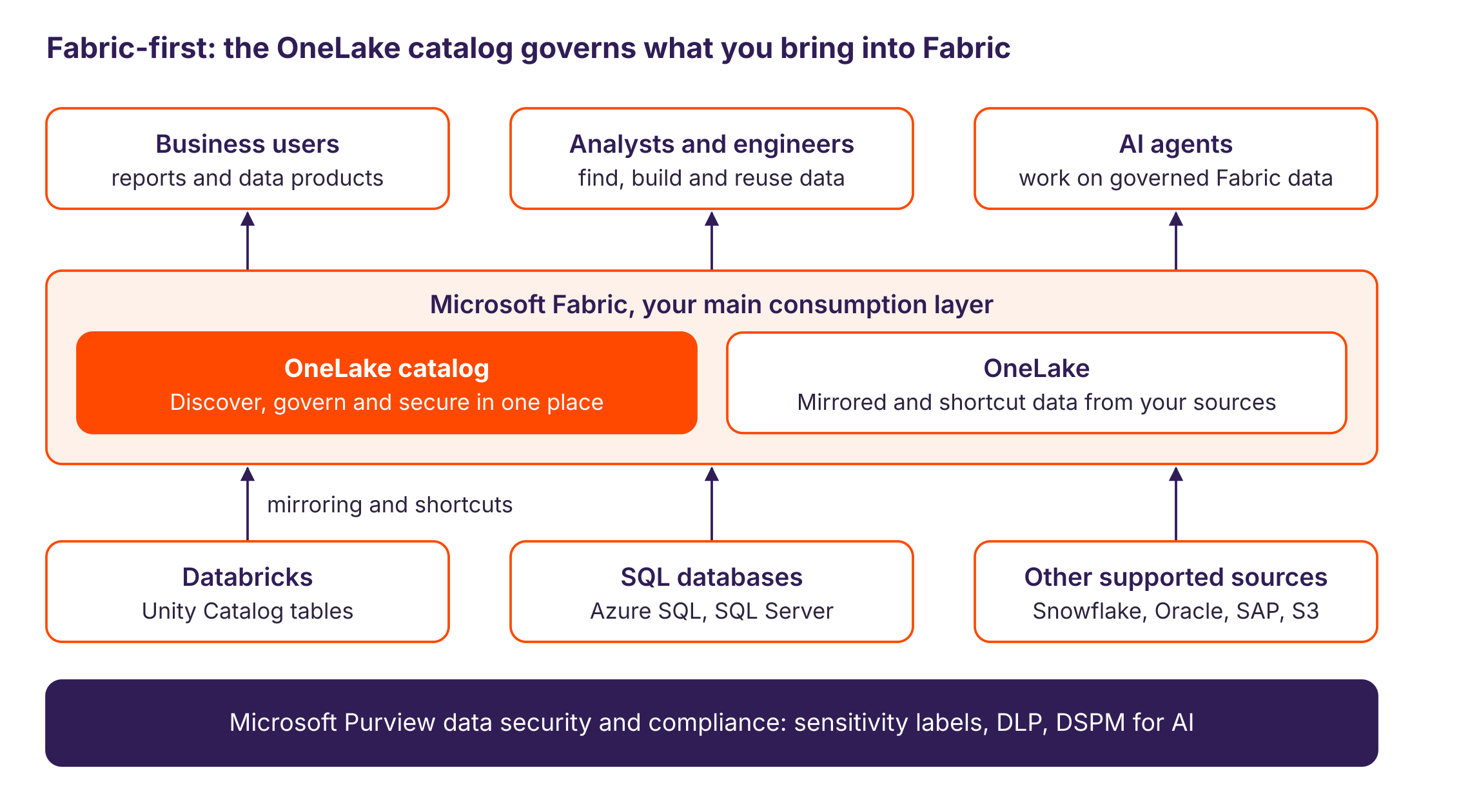
Data reaches OneLake through mirroring and shortcuts, and people and agents consume it in Fabric. Mirroring covers Azure SQL, SQL Server, Snowflake, Oracle, SAP and Databricks Unity Catalog, among others. Shortcuts cover ADLS, Amazon S3, Google Cloud Storage and Dataverse. Security set at the source does not always travel with the data: for Snowflake, Microsoft's documentation says granular permissions have to be set up again in Fabric. This picture holds as long as your sources are on the supported list and you answered the two highlighted questions in the decision tree in favour of OneLake.
AI and agents: where do we store our context
An agent that answers a revenue question needs the same things a new colleague needs: what the term means, which table is the trusted one, who owns it, and what it may be used for. That context is exactly what a glossary and a set of data products hold.
So the catalog decision is also an AI decision. Check that the context covers every platform your agents will query, and that an agent can read it through an API or an MCP server with permissions respected. Check too that business owners maintain it in a tool they are willing to open.
Fabric has its own answer for data inside Fabric. If your agents also work on Databricks or Snowflake data, the context needs a home above the platforms.
What should you do now
Keep governing. Purview Data Governance is supported until 12 November 2027, and the work your stewards do today moves with you.
- Take stock of what lives in Purview: glossary terms, governance domains, data products, data quality rules, scans, workflows and every integration built on the Atlas API.
- Make your content portable. Publish the Unified Catalog metadata to OneLake or ADLS with self-serve analytics, and pull technical metadata from the Data Map through its APIs. Definitions and ownership are the asset; the tool is replaceable.
- Map your estate. Mostly Fabric, or a large share on Databricks, Snowflake, SAP and on-premises databases? The answer decides most of the decision tree above.
- Decide source by source. An organisation rarely fits one path as a whole. Sort each source and each requirement into four groups: move to OneLake now, run both for a while, bridge with another tool, or redesign.
- Evaluate the OneLake catalog when its governance features start rolling out in 2027. Put each release in front of a few business users, and check it against the governance features and workflows you use in Purview today. That answers the two highlighted questions mentioned earlier.
- Look at an enterprise data catalog in parallel if you already expect a no. OvalEdge and dScribe are commercial candidates, DataHub and OpenMetadata open-source ones. Check their connectors for OneLake and Unity Catalog and whether agents can read them through an API. Then let a few business users try them.
- Leave data security where it is. Sensitivity labels and DLP stay in Purview, and those projects continue as planned.
- Start new governance initiatives outside Purview Data Governance. Microsoft's documentation states that new accounts can no longer be created, so greenfield work begins in Fabric or in your enterprise data catalog.
Set a decision date for mid-2027. By then the first governance features in the OneLake catalog can hopefully be judged on what they do, and there is still time to migrate before support ends. Plan that migration now.
Sources
- Update on the Microsoft Data Governance strategy, Microsoft Partner Center announcements, 12 November 2026
- A next step in the evolution of the Microsoft Data Governance strategy, Microsoft Security Blog on Tech Community, November 2026
- From Purview Data Governance to the Fabric OneLake Catalog, Microsoft Tech Community, 13 November 2026
- Data governance with Microsoft Purview, Microsoft Learn, retirement notice
- Self-serve analytics and insights, Microsoft Learn
- Get started with mirroring in Fabric, OneLake shortcuts and Mirroring Snowflake, Microsoft Learn
