


Advanzia Bank is a leading European digital bank and a major Cards-as-a-Service provider, serving 2.8 million credit card customers and growing at 9.9% a year. That growth increasingly tested the limits of an analytics estate still built around on-premises SQL Server. In 2024, Advanzia set out to modernise the platform without creating a long period of disruption for the business. The core migration to Azure Databricks was delivered in under a year, giving the bank a platform that is more stable, scalable and performant, while creating a governed foundation for self-service analytics and machine learning.
13x the data volume. About 5x faster for the ML workload. Core migration delivered in under a year.
The customer at a glance
| Fact | Detail |
|---|---|
| Organization | Advanzia Bank S.A. (Luxembourg) |
| Industry | Financial services - digital banking, Cards-as-a-Service |
| Scale | 2.8 million credit card customers; 9.9% annual growth rate |
| People | More than 240 employees, 36 nationalities |
| Challenge | On-premises SQL Server estate: challenged by growth and performance limits; limited self-service |
| Solution | Azure Databricks Lakehouse with Unity Catalog, MLflow, Power BI and Microsoft Purview |
| Partner | element61 |
| Timeline | Migration completed in under one year (2024-2025) |
As a fully digital bank, Advanzia relies on data across onboarding, risk, customer service, regulatory reporting and partner operations. It also works with companies, associations and financial institutions on white-label card programs, so reliable data is woven into both day-to-day operations and the services it provides to partners.
The challenge: preparing the data platform for future growth
Data was already central to the business - to manage risk, monitor performance and report to authorities and partners - but by 2024 the platform underneath it was becoming harder to rely on.
Where the pressure was showing
Nightly loads and reporting were increasingly difficult to keep within service levels, while model retraining remained a slow and cumbersome exercise. Business users needed greater transparency and a single source of truth for their data, and the lack of self-service meant that even relatively simple questions kept flowing back to a small technical team. At the same time, demand was moving towards real-time data and more freedom to explore it.
The decision: a structured selection, proven before committing
Rather than selecting a technology first, Advanzia and element61 jointly defined the future-state capabilities, target architecture, governance requirements and operating model. This shared design effort became the basis for the technology selection and ensured alignment with Advanzia’s business objectives and long-term ownership requirements.
From market scan to board approval in three months
The selection ran over three months, with each phase building confidence before the final recommendation.
Month 1 focused on orientation and narrowing the field. Advanzia evaluated the market, met vendors, assessed technology options and identified the right implementation partner.
Month 2 moved into proof of value. Real stakeholders, high-value use cases and explicit success criteria were used to validate the architecture building blocks on an experimental platform and to measure actual costs.
By month 3, the evidence was strong enough for board-level decision-making. Advanzia could compare costs and benefits and present a concrete recommendation, including the target landscape, business case and implementation plan.
That process led to Databricks as the enterprise data platform on Azure, supported by a coherent technology stack: Data Factory and Event Hub / Kafka for ingestion, dbt for transformation, Unity Catalog and Microsoft Purview for governance, MLflow for machine learning operations, and Power BI and Excel for consumption.
What Advanzia needed from a partner
For Advanzia, selecting the right technology was only part of the equation. The transformation also required a partner able to turn the target architecture into a pragmatic migration approach and work closely with the internal teams throughout the journey.
The emphasis was on combining strong technical expertise with proven delivery patterns: validating key choices through a proof of value, standardising the migration wherever possible and keeping business continuity at the centre of the program. Just as importantly, the collaboration had to go beyond implementation. Governance, data quality, knowledge transfer and enablement were built into the journey so that Advanzia’s own teams could progressively take ownership of the new platform.
This close partnership between Advanzia and element61 helped turn what could have been a long-running technology migration into a structured transformation with a clear path towards adoption and ultimately the retirement of the legacy platform.
The solution: one platform, one operating model
Advanzia treated the platform and the operating model as one design problem. The target model clarified not only which tools would be used, but who would own each capability. Data engineers, platform engineers, data scientists, ML engineers, BI engineers, analysts, data managers, owners and stewards all had a defined place in the model. Databricks sat at the centre, bringing ingestion, processing, analytics and machine learning onto a common governed platform rather than leaving them as separate technology islands.
| Capability | Tooling | Roles |
|---|---|---|
| Ingestion & processing | Databricks, Data Factory, Event Hub, dbt | Data engineer |
| Machine learning | Databricks, MLflow | Data scientist, ML engineer |
| Data governance | Unity Catalog, Microsoft Purview | Data manager, data owner & steward |
| Dashboarding & analytics | Power BI, Excel | BI engineer, data analyst |
| Platform engineering | Azure, Databricks | Platform engineer |
Empowering every function
Enablement was built into the program from the start. Role-based courses from Databricks Academy and the element61 Academy helped teams grow into the new platform, with certification encouraged as a way to make the new skills visible and reusable.
One migration decision that shaped everything
One of the most important decisions was how to migrate the existing warehouse. A greenfield built alongside the old platform offered the attraction of a clean model, but also meant a long parallel run, more fragmentation and a real risk that the legacy warehouse would never disappear. Advanzia instead chose a one-to-one migration of the data warehouse to Databricks. It accepted the upfront cost and some inherited modelling weaknesses in exchange for a much simpler transition for users and a realistic path to decommissioning the old environment.
Scope discipline: prioritise by business value
The migration scope was then filtered through business value. Every script and report was discovered, assigned to a named owner and prioritised from P1 (critical) to P4 (not relevant). That materially reduced the amount of work that actually had to be migrated, while also creating clear ownership of the data assets.
By forcing every asset to have an owner and a business priority, the migration itself became the first practical step in the new governance model.
The roadmap and the seamless phase-out
From there, the program progressed across five connected tracks: data lake foundations, data governance, change management, reporting and analytics, and machine learning. They ran in parallel because this was not simply a platform replacement: the operating model, ownership, self-service capabilities, enablement and ML roadmap all had to evolve with it. The final step was a controlled phase-out of the legacy environment.
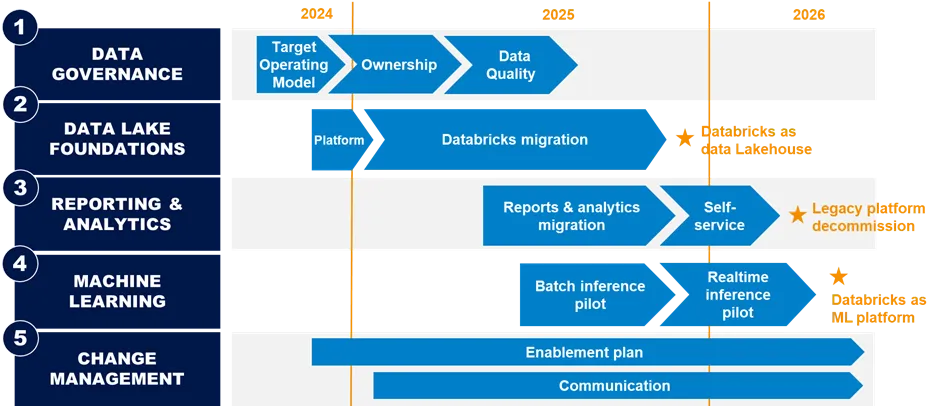
The multi-track roadmap, from data lake foundations to legacy decommissioning.
That phase-out followed a deliberate sequence. Advanzia first proved parity between the old and new platforms, then ran them side by side while monitoring usage. Access to the legacy environment was progressively reduced only after confidence was established, with communication running throughout the transition. The legacy data warehouse platform was fully retired in October 2026.
Built to stay up
Resilience received the same attention as performance. Multiple disaster recovery options were reviewed collaboratively and compared on availability, resilience and risk. In a banking context, this was not a secondary infrastructure topic: data availability directly affects operations, customers and trust.
Making the data easier to trust
Governance and data quality were made visible in day-to-day operations. Microsoft Purview gives business teams a place to document and understand their data assets, while the element61 governance kit tracks coverage across the estate. In parallel, the element61 data quality kit monitors rules on those assets so that quality can be measured instead of debated. On the consumption side, users moved away from the traditional Report Server experience towards modern Power BI apps.
The results

The outcomes map directly back to the objectives set at the start of the program.
| Objective | Outcome on Databricks |
|---|---|
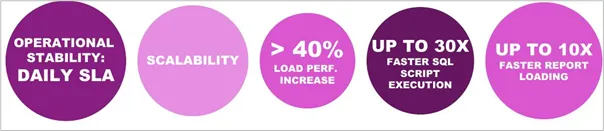
| Operational stability | Daily SLA met - data available by 9 AM |
| Load performance | More than 40% increase in nightly data load performance |
| Query performance | Up to 30x faster SQL script execution |
| Reporting performance | Up to 10x faster report loading |
| Scalability | Platform scales with volume instead of constraining it |
| Machine learning | 12x more rows and 1.1x more columns in the training set - around 13x the data volume - executed roughly 4.8x faster |
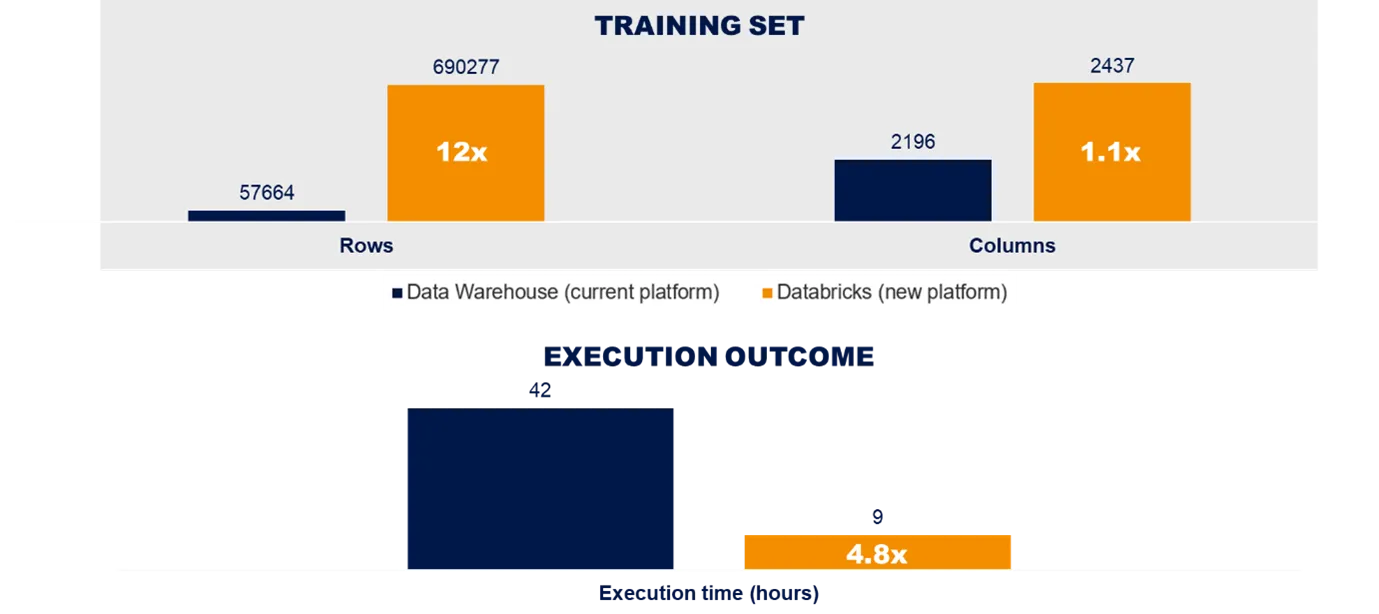
MLOps performance outcomes: a far larger training set, executed in a fraction of the time.
The MLOps result is a useful illustration: the training set grew from 57,664 to 690,277 rows and from 2,196 to 2,437 columns, while execution time fell from 42 hours to 9 - roughly 13x the data volume in about one-fifth of the time.
Customer perspective
“This transformation was about preparing Advanzia for the future, not simply replacing technology. Our objective was to build a scalable and governed data foundation that can grow with the business, support innovation and help our teams make decisions with greater confidence in the data they use every day. The migration itself was an important milestone, but the real value is in the platform, governance and capabilities we now have in place to accelerate analytics, AI and data-driven decision-making as we continue to evolve.”
Maxime Thiel, Head of Architecture & Technology – Advanzia Bank
From reporting to conversation
Once the governed Lakehouse was in place, Advanzia could move beyond traditional self-service reporting. Business users can now ask questions in business language and get answers without needing to write SQL or route every request through a technical team, while remaining inside the governed data environment. The important shift is not the interface itself; it is that self-service can scale without bypassing governance.
Self-service became less about adding another report to a backlog and more about giving users a governed way to explore the data themselves.
Lessons learned
Several lessons from the program are less about Databricks than about how to make a transformation like this work. The first was to treat the business, internal technology teams and partners as one delivery team. Standard migration patterns also mattered: with hundreds of assets in scope, solving each one as a special case would have made the program impossible to scale. Just as importantly, the team kept prioritising by business value rather than migrating everything simply because it existed.
The other lessons were organisational. Ownership of scripts, reports and data assets had to be explicit. Communication had to be repeated throughout the phase-out, not left until go-live. And the people expected to operate the new platform needed time and training to grow into it. The technology accelerated the work, but adoption and decommissioning depended on those disciplines.
Why it worked
What made the program effective was the sequence of decisions. Advanzia first defined the capabilities it needed and used a proof of value to test the architecture and economics before committing. It then chose a one-to-one migration because a realistic path to decommissioning mattered more than a perfect greenfield model. Databricks provided the shared platform; ownership, governance, quality and enablement made it sustainable.
More information
For more information, please contact us!
