


Microsoft enters the world of Planning, budgeting, and forecasting: A First View on Microsoft Fabric Planning.
Intro
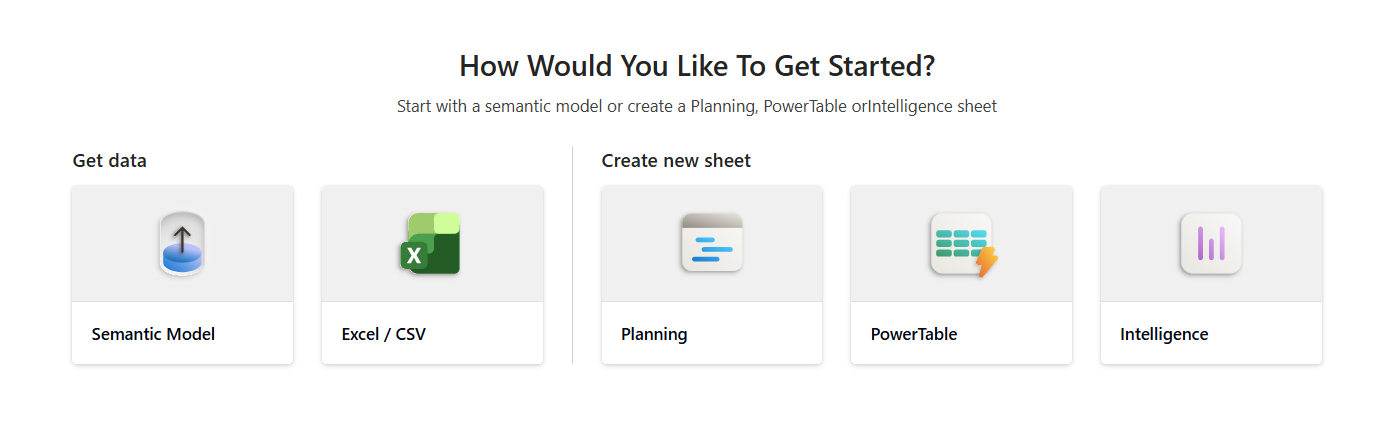
Microsoft Fabric Planning puts budgeting, forecasting, scenario modelling and analytics in the same Microsoft-governed platform as your data and Power BI models.
It doesn't try to out-feature the mature planning tools on the market. It removes the wall between actuals, plans and reporting. If you have already invested in MS Fabric, that alone makes it worth a look at Planning in MS Fabric, also referred to as Fabric Plan.
From historical reporting to a closed planning loop
For years, BI and Performance Management have lived side by side, never quite together. BI tells you what happened. Planning tools model what's coming. In between, Finance teams still lose real-time reconciling numbers, checking whether the budget, the forecast and the management report still tell the same story.
Fabric Planning changes that. It's a CPM solution built straight into Fabric, running budgets, forecasts and scenarios in the same governed environment as your data, analytics and AI. Plans, actuals and goals share one semantic model, one security model, one set of business logic. No separate tech stack, unlike most other CPM tools.
Our take: the real innovation isn't a new spreadsheet-style planning grid. It's having one single data foundation for actuals, plans, reporting and AI-assisted decisions.
What is included in Fabric Planning
The capability comes as an integrated suite. Each component covers a different part of the planning process. They're complementary, not interchangeable.
| Component | Role in the planning landscape |
|---|---|
| Planning sheets | A spreadsheet-style workspace for budgeting, forecasting, assumptions, calculated outcomes, what-if analysis and scenario comparison. |
| PowerTable sheets | A table-based workspace for larger, more operational datasets. Build collaborative table apps directly on semantic models, no code needed. Insert new master data on the fly, as you plan. |
| Intelligence sheets | Analytical views for trends, variances and forward-looking insight on your planning data. |
| Infobridge | The integration layer. Connects data across models and systems so planning stays aligned with the rest of your Fabric estate. |
Why this matters for Finance Teams and beyond
Actuals and plans can share one governed foundation
Planning runs on Fabric semantic models. Finance works with the same definitions, dimensions and models used in enterprise reporting, no translation layer in between. Planning results write back to a SQL database in Fabric, so they're available downstream right away. That shortens the path from source data to forecast, and from forecast to management report.
This doesn't remove data engineering. It just moves where the effort goes. Semantic model quality, master data, time intelligence, ownership of business definitions: all of it matters more now, not less. The model isn't just feeding reports anymore. It's the foundation for data entry, calculation and decisions too.
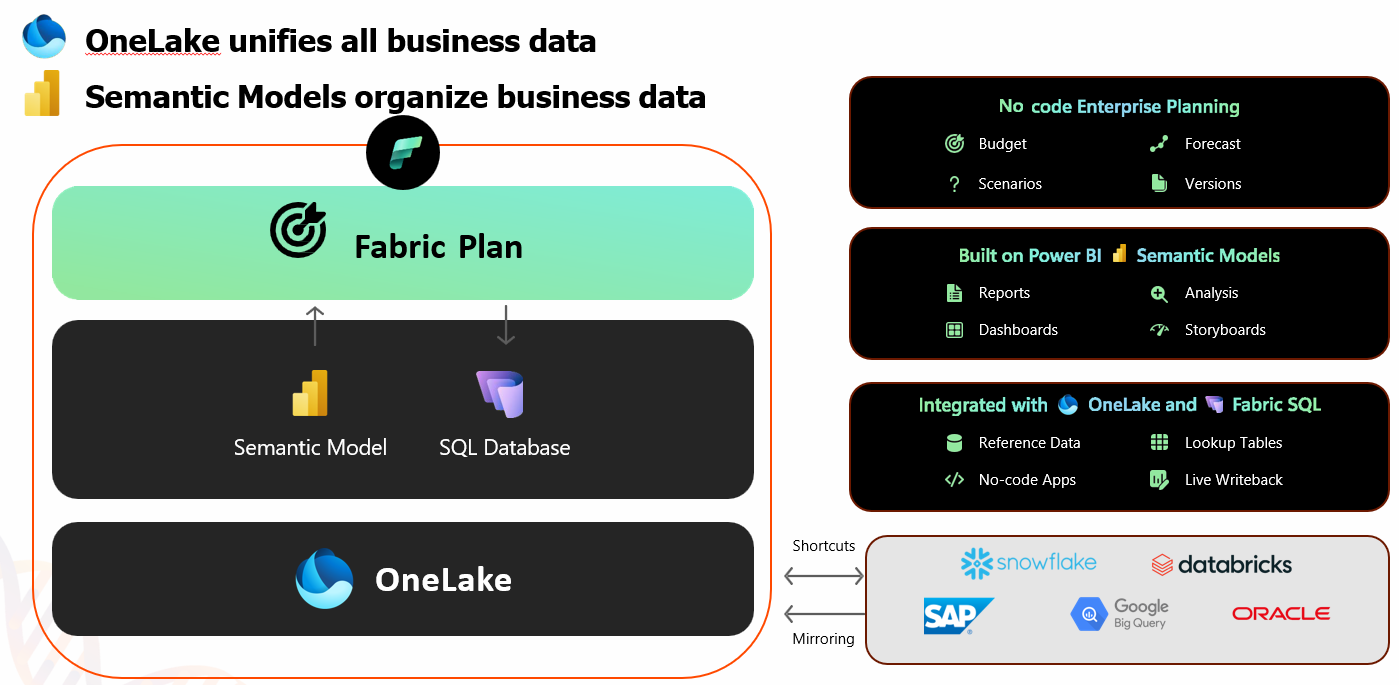
Plans and actuals share the same governed estate, so there's no pipeline to maintain between them and no separate warehouse for plan data. Variance in Power BI and variance inside the planning tool come from the same underlying numbers, so they stay reconciled by default — not something that gets re-checked and patched every cycle. For data that lives outside Fabric — Snowflake, Databricks, BigQuery, SAP, Oracle — OneLake mirroring and shortcuts bring it in without a bespoke ETL pipeline.
Microsoft Fabric Planning allows to plan on your entire data estate, as shown in the image below.
Planning becomes part of the analytics experience
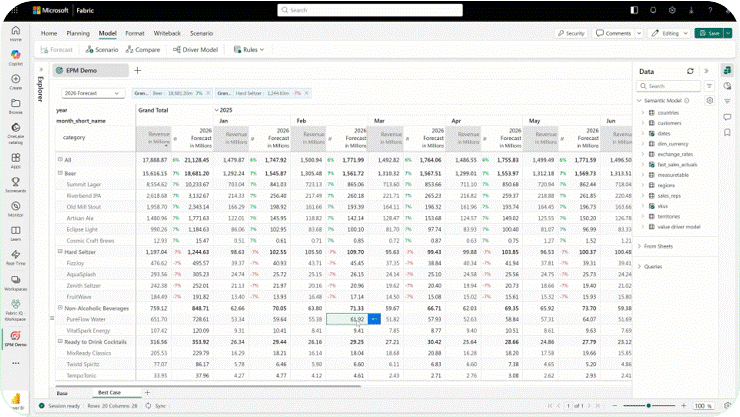
Finance users still get the Excel-like, grid-based feel they're used to. The organization keeps the broader Fabric context around it: data, security, administration. We tested budget and forecast measures, top-down and bottom-up forecasting, scenarios, distribution rules, locking, comments, audit trails, writeback and multidimensional allocations with driver measures. It holds up.
This matters most when many occasional contributors need to feed in assumptions or plan values. A browser-based tool connected to the governed model cuts down on emailing spreadsheet copies around and consolidating them by hand. Finance still controls the structure.
The architecture is ready for more continuous planning
Annual budgeting usually lags: actuals, revised assumptions and a new outlook arrive far apart. MS Fabric Planning brings continuously refreshed operational data, history and projections into one place. That opens the door to a faster planning rhythm. But the tool alone won't get you there. Process, ownership and decision cadence have to change too.
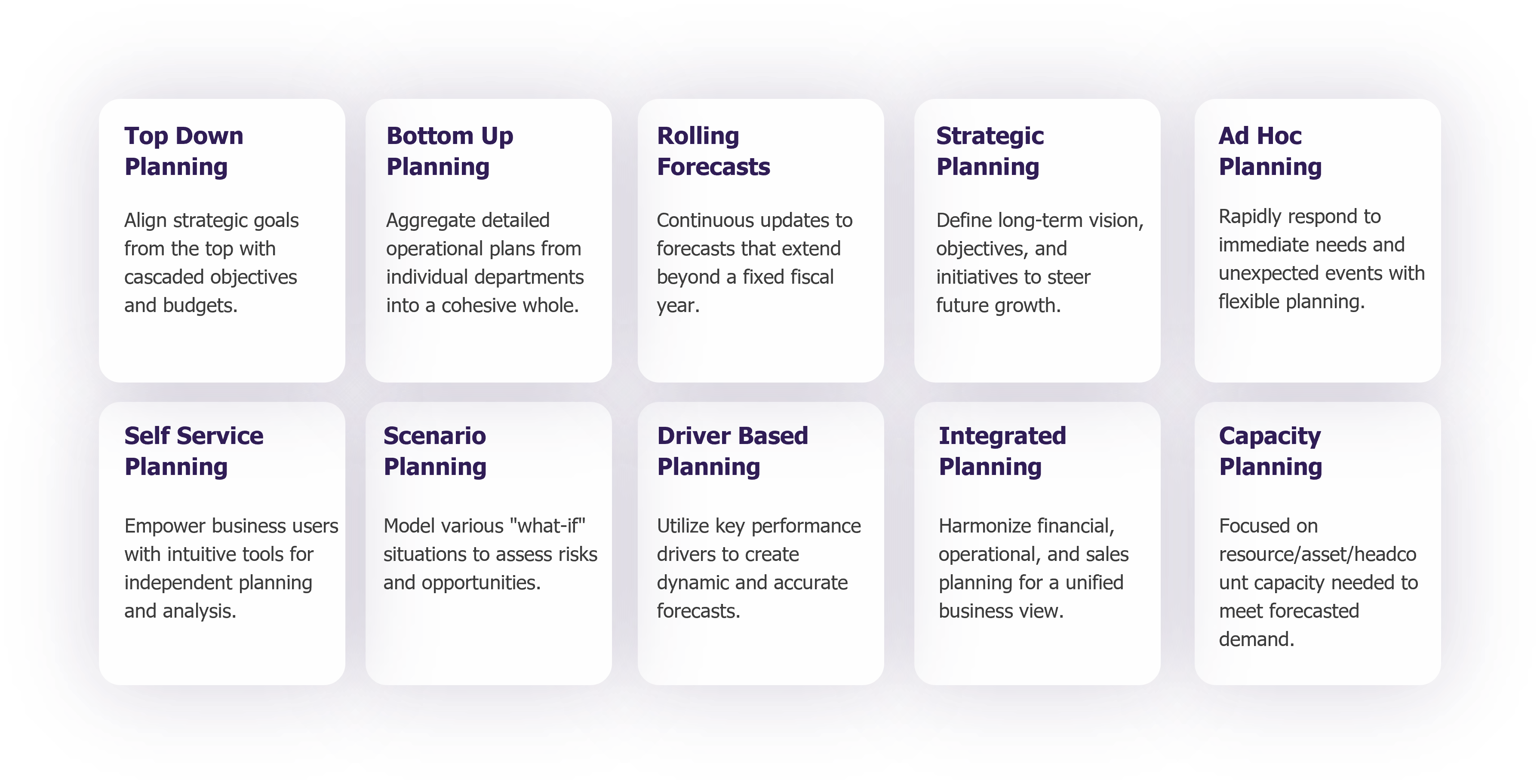
Planning in Fabric supports the full spectrum of planning approaches organizations actually need — not just one methodology:
Finance and beyond
| Domain | Use Case |
|---|---|
| Sales | Revenue Forecasting, Quota & Territory Planning, Commission & Incentive Modeling, Monitor deal health, conversion rates, and pipeline coverage |
| Finance | Budgeting & Forecasting, Integrated Plans (xP&A - sales, HR, and operations), Financial Reporting (GAAP/IFRS), Audit Trail & Governance Pipeline forecasts and revenue targets feed your top-line projections in real time. Headcount and compensation changes update your largest P&L line item instantly. Supply chain costs, inventory, and CapEx connect to working capital and cash flow forecasts automatically. |
| Operations | Capacity & Production Planning, KPI Scorecards & Monitoring, Process Efficiency & Overall Equipment Effectiveness, Simulate disruptions in supplier handlings, tariffs, etc |
| Supply Chain | Demand Planning & Forecasting, Sales & Operations Planning (S&OP), Inventory & Stock Optimisation, Procurement & Supplier Planning |
| Human Resources | Headcount & Capacity Planning, Compensation & Benefits Budgeting |
| Project Management | Project Budget Tracking, Resource Allocation & Capacity |
A practical example: from P&L reporting to driver-based forecasting
Take an organization already reporting P&L in Power BI. The semantic model already holds the chart of accounts, organizational dimensions and actual financial measures. Fabric Planning uses that same model as the starting point for a planning sheet.
From there, Finance can:
- Build budget and forecast measures straight from historical actuals, no more exporting a static copy of the report.
- Apply assumptions at total, entity, cost-center or account level, and push them down using defined methods or driver weights.
- Build base, best-case and worst-case scenarios, compare them and promote the one you agree on.
- Use audit trails, comments, permissions and locking to keep the process under control.
- Write approved planning data back to Fabric SQL, ready for Power BI reporting and everything downstream.
The same logic works for workforce planning, product profitability, sales capacity, working capital or cash flow planning. Fabric Planning gives you formulas, dimensional models and driver-based allocations, all built on the semantic models you already have.
Our Verdict
Fabric Planning is one of the most strategically relevant components Microsoft has added to Fabric for finance teams. It puts planning right where many organizations already keep their governed data and reporting logic. Less reconciliation, better traceability, planning that's actually connected to day-to-day performance.
Don't dismiss it because it's new. Don't assume it replaces every mature CPM tool either. If you have a solid Fabric foundation and a clear planning use case, evaluate it now. Test the semantic model, the modelling depth, workflow, security, writeback, capacity consumption and user experience against your own requirements, not the demo.
The bigger prize is a closed loop: actuals, forecasts, scenarios, insight and decisions, all on one governed foundation. Fabric Plan is the first time that architecture feels within reach. Contact us for a demo, a discovery session or if you just want to receive some more information on Micrsoft's newest kid on the block in the Performance Mangement space.
FAQ
Microsoft Fabric Planning, also referred to as Fabric Plan, is a CPM solution built straight into Microsoft Fabric. It runs budgets, forecasts, and scenarios in the same governed environment as your data, analytics, and AI. Plans, actuals, and goals share one semantic model, one security model, and one set of business logic, with no separate tech stack.
We see the difference as architectural rather than feature-driven. Fabric Planning doesn't try to out-feature the mature planning tools on the market - it removes the wall between actuals, plans, and reporting. Unlike most other CPM tools, it needs no separate tech stack, so plans and actuals sit in the same governed estate with no pipeline to maintain between them.
The capability comes as an integrated suite of four complementary components. Planning sheets are a spreadsheet-style workspace for budgeting, forecasting, assumptions, what-if analysis, and scenario comparison. PowerTable sheets handle larger, operational datasets as no-code table apps on semantic models. Intelligence sheets give trends, variances, and forward-looking insight. Infobridge is the integration layer that keeps planning aligned with the rest of your Fabric estate.
Finance works with the same definitions, dimensions, and models used in enterprise reporting, with no translation layer in between. Planning results write back to a SQL database in Fabric, so they are available downstream right away. Variance in Power BI and variance inside the planning tool come from the same underlying numbers, so they stay reconciled by default instead of being patched every cycle.
No. In our view, it moves where the effort goes rather than removing it. Semantic model quality, master data, time intelligence, and ownership of business definitions matter more now, not less, because the model is no longer just feeding reports. It becomes the foundation for data entry, calculation, and decisions too. element61 can help you get that foundation right; contact us.
Yes. For data living in Snowflake, Databricks, BigQuery, SAP, or Oracle, OneLake mirroring and shortcuts bring it into Fabric without a bespoke ETL pipeline. That is what lets you plan on your entire data estate rather than on a carved-out extract, and it keeps planning aligned with the operational systems your data already lives in.
Finance users still get the Excel-like, grid-based feel they are used to, while the organization keeps the broader Fabric context around it: data, security, and administration. This matters most when many occasional contributors feed in assumptions or plan values - a browser-based tool on the governed model cuts down on emailing spreadsheet copies around and consolidating them by hand. Finance still controls the structure.
We tested budget and forecast measures, top-down and bottom-up forecasting, scenarios, distribution rules, locking, comments, audit trails, writeback, and multidimensional allocations with driver measures. It holds up. We conclude that the modelling depth is real, but you should still test it against your own requirements rather than against the demo.
Planning in Fabric supports the full spectrum of planning approaches organizations actually need, not just one methodology. We see use cases in sales (revenue forecasting, quota and territory planning, commission modelling), operations (capacity and production planning, KPI scorecards, OEE), supply chain (demand planning, S&OP, inventory optimisation), HR (headcount and compensation budgeting) and project management (budget tracking, resource allocation).
Take an organization already reporting P&L in Power BI. That semantic model becomes the starting point for a planning sheet: build budget and forecast measures from historical actuals, apply assumptions at total, entity, cost-center or account level, push them down with driver weights, compare base, best-case and worst-case scenarios, and write approved data back to Fabric SQL for downstream reporting.
The architecture is ready for it. Fabric Planning brings continuously refreshed operational data, history and projections into one place, which opens the door to a faster planning rhythm than the usual annual budget lag. But the tool alone won't get you there - process, ownership and decision cadence have to change too. Reach out for a tailored roadmap.
We recommend not dismissing it because it's new, and not assuming it replaces every mature CPM tool either. If you have a solid Fabric foundation and a clear planning use case, evaluate it now: test the semantic model, modelling depth, workflow, security, writeback, capacity consumption and user experience against your own requirements. element61 can help - get in touch.