

Ardo is one of Europe's leading producers of fresh frozen vegetables, fruit and herbs. Across 16 sites in seven countries, it distributes close to one million tons each year and exports to more than 100 countries. When its new operating model and SAP S/4HANA program began reshaping the business, the existing analytics landscape was no longer enough. Since then, Ardo has moved from a largely sales-focused BI environment to a broader modern data platform strategy spanning reporting, self-service, innovation and advanced analytics. Just as importantly, the data team started moving from responding to report requests to contributing directly to strategic business projects.

This was not a greenfield transformation. Ardo already had BI, live reports and an established data warehouse. The challenge was to modernise without stopping what already worked, while giving the organisation a much clearer direction for what came next.
The customer at a glance
| Fact | Detail |
|---|---|
| Organisation | Ardo - fresh frozen vegetables, fruit and herbs |
| Footprint | 16 sites across 7 countries; exports to more than 100 countries |
| Scale | 1.4 billion euro annual revenue; close to 1 million tonnes distributed yearly |
| People | Over 3,300 team members; 3,500 growers working with 65 agronomists |
| Challenge | Scattered ERP and reporting landscape; a sales-focused on-premises data warehouse; no analytics strategy for a new operating model |
| Solution | A modern data platform architecture harmonising BI, innovation and machine learning, with Power BI self-service on top |
| Partner | element61 |
| Timeline | Strategy and roadmap in 6 weeks; delivery and adoption continuing today |
Ardo's business runs from field management and harvest through processing, freezing, storage and distribution. That end-to-end value chain generates data at every step, creating opportunities to improve planning, quality, inventory, service levels and commercial decisions.
The starting point: analytics everywhere, strategy evolving
At the start of the journey, Ardo had a small internal BI team and an on-premises data warehouse that had been running since 2018, mainly focused on Sales and connected to a fragmented ERP landscape. That setup had served the organisation, but it had not been designed for the new operating model, the SAP roll-out or the much broader ambition around analytics and AI. There was no greenfield option: existing reporting had to keep running while the architecture, skills and way of working evolved. At the same time, the wider IT landscape was changing quickly, both inside and outside SAP.
Looking deeper: analytics everywhere
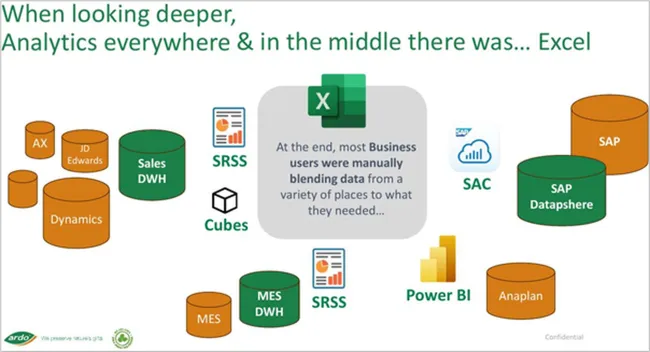
Looking across the estate showed just how fragmented the experience had become. Data lived across Dynamics, JD Edwards, AX, the Sales data warehouse, SAP and SAP Datasphere, SSRS, cubes, SAC, MES systems, Anaplan and Power BI. In practice, Excel often became the integration layer: business users manually combined data from several places to get the view they needed.
The real question was not which reporting tool to buy; it was how to build the governance, ownership, skills and self-service model around the technology.
The decision: a partner, and six weeks to a clear direction
Ardo concluded that it needed a short but thorough strategy exercise before committing to a new architecture. The goal was not simply to pick a platform; it was to define a high-performing analytics organisation: one way of working, a single source of truth, a common reporting approach, the ability to combine multiple data types and sources, managed self-service and a credible path towards advanced analytics and machine learning.
What Ardo needed from a partner
Ardo was looking for more than technical expertise. The ambition required a partner with a proven track record, but also a pragmatic approach: people who could translate the strategy into tangible business value, bring proven accelerators and reusable approaches where they made sense, and work side by side with Ardo rather than delivering from a distance.
That co-development model was important from the start. The objective was not only to deliver a modern analytics platform, but also to strengthen Ardo’s own capabilities along the way. By combining experienced consultants with coaching, knowledge transfer and a focus on reusable building blocks, the partnership was designed to create momentum quickly while leaving Ardo with a model it could continue to grow and operate itself.
Six weeks to turn ambition into a roadmap
| Step | What | Weeks |
|---|---|---|
| 1 | As-is map and technical audit - understand workshops, technical audit, get access | Weeks 1-2 |
| 2 | To-be architecture - to-be workshops | Weeks 3-4 |
| 3 | Concrete use cases - define use cases | Week 5 |
| 4 | How to deliver - workshops, document, timeline, management presentation | Weeks 6-7 |
The exercise deliberately addressed the difficult choices rather than postponing them. Should end users work in SAC or Power BI? How should SAP Datasphere and Microsoft Azure fit together? Which roles and responsibilities were needed across analytics and AI? And how could Ardo modernise while the existing backlog was already large? The purpose of the roadmap was to make those trade-offs explicit and turn them into a sequence that could actually be funded and delivered.
Ardo's phrase for it was simple: it wanted to act, but first it needed to know how to cut the elephant into manageable pieces.
The strategy: five pillars
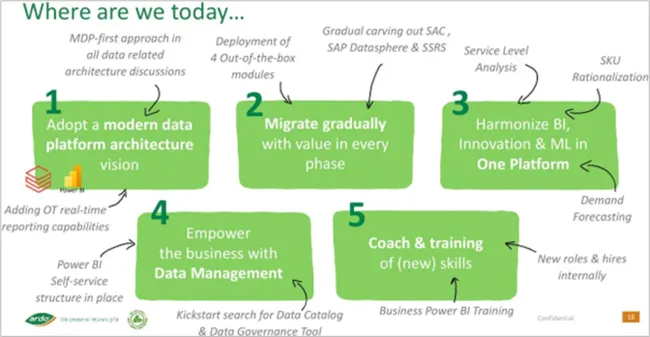
The roadmap translated Ardo’s analytics strategy into five clear pillars. Together, they created a practical direction for modernising the platform, delivering business value step by step, and building the capabilities needed to sustain the change.
- Modern data platform. Ardo would move towards a modern data platform architecture instead of continuing to add isolated point solutions.
- Gradual migration. Migration would happen progressively, with business value delivered in every phase rather than waiting for a full transformation to be complete.
- One platform for BI, innovation and machine learning. BI, innovation and machine learning would be brought together on a common foundation instead of being developed in separate stacks.
- Data management and governance. Data management and governance would become a business capability, not only an IT concern, with clearer ownership and roles around data.
- Coaching and training. Ardo would invest in coaching and training so that new skills could grow alongside the platform and the future model would remain sustainable.
The third pillar — bringing BI, innovation and machine learning together on one platform — was particularly important. Ardo did not want one environment for BI, another for data science and a third for experimentation. The target was a common foundation where reporting, advanced analytics and machine learning could use the same data and evolve together. That reduced the risk of creating yet another silo while still allowing the organisation to modernise step by step.
Where Ardo is today
Today, the strategy is visible in both architecture and delivery. The table below shows how the five principles have translated into concrete changes across the platform, migration, advanced analytics, data management and user enablement.
| Pillar | In production today |
|---|---|
| Modern data platform | A modern-data-platform-first approach in every data-related architecture discussion |
| Gradual migration | Gradual carving out of SAC, SAP Datasphere and SSRS; SKU rationalisation; adding OT real-time reporting capabilities |
| One platform for BI, innovation & ML | Demand forecasting and service level analysis running alongside reporting |
| Data management | Kickstarted the search for a data catalog and data governance tool; new roles and hires internally |
| Coaching & training | Business Power BI training; a Power BI self-service structure in place; 4 out-of-the-box modules deployed |
The results Ardo is proud of
Adoption, not just delivery
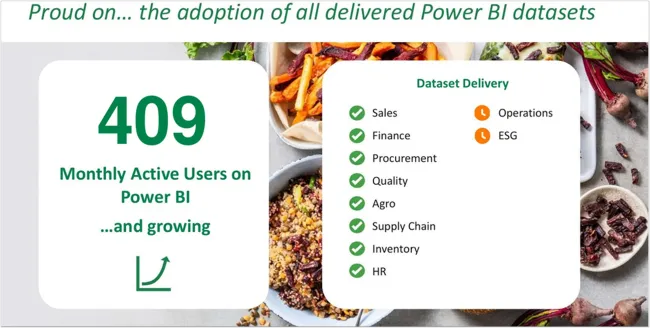
The clearest proof is adoption. Monthly active users in Power BI continue to grow as new datasets are delivered across Operations, ESG, Sales, Finance, Procurement, Quality, Agro, Supply Chain, Inventory and HR. Ardo's measure of success is therefore not only whether a dataset goes live, but whether it becomes part of how the business actually works.
Data-driven support on core strategic KPIs
That adoption matters because the platform is now used to track and improve core strategic KPIs, for example On Time In Full delivery. Analytics is increasingly tied to operational performance rather than treated as a separate reporting activity.
A different conversation with the business
The change is also visible in the conversations with the business: the data team is moving from ‘build me a table view with columns XYZ’ towards being a partner in strategic business projects.
Ardo, on the increased impact of the data & analytics strategy
The data products
The current data products illustrate Ardo's broader approach: solve a concrete business problem now, but structure the underlying data so that the next use case can build on the same foundation.
Commercial cockpit (Sales)
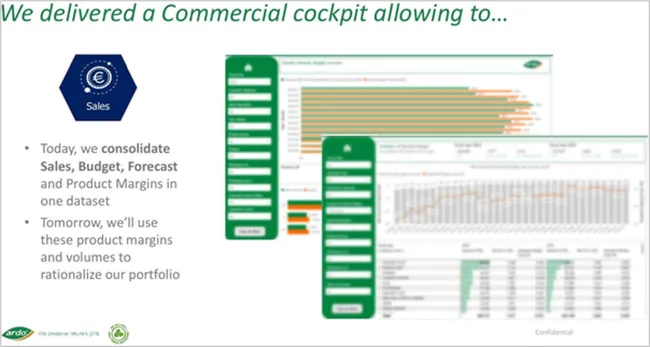
The Commercial Cockpit brings sales, budget, forecast and product margins together in one dataset. That already gives the commercial team a more coherent view of performance; the same margins and volumes can later support portfolio rationalisation.
Agriculture report (Agro)
The Agriculture report turns sowing and harvesting activity into an actionable operational view. Over time, that same data can help adjust production plans based on the quantity and quality of the harvest.
Inventory cockpit
The Inventory Cockpit gives planners a clearer view of stock health today. A future extension could combine that view with forecasted sales orders to optimise where bulk inventory is stored.
Quality cockpit
The Quality Cockpit provides a shared dataset and an initial set of reports to support Ardo's quality standards. From there, Power BI power users can continue building new reporting on the same data rather than creating separate extracts and silos.
Across all four examples, the pattern is the same: the first report is not the endpoint. The data is organised so that forecasting, optimisation or machine learning can be added later without starting a new data project from scratch.
Lessons learned
Ardo summarises its experience into three practical tips for organisations starting a similar analytics journey:
- Do not reinvent the wheel. Use proven architectures, out-of-the-box modules, kits and templates where they make sense. They remove avoidable effort and help the team focus on the business-specific challenges.
- Start with visible business value. A lighthouse project that solves a real business problem creates more momentum than positioning the transformation as an IT programme.
- Create mandate before accelerating. The six-week roadmap gave Ardo a shared direction and sequencing. Once the organisation was aligned on the destination, individual projects could move with much more confidence.
Why it worked
Ardo's journey worked because the organisation resisted the temptation to begin with a tool decision. The six-week roadmap connected the new business strategy to a practical architecture and delivery sequence, while the gradual approach meant value could be shown without stopping the existing estate. Bringing BI, innovation and machine learning into the same platform direction also means that today's cockpits and reports can become the foundation for tomorrow's forecasting and optimisation, rather than another set of isolated solutions.
More information
For more information, please contact us!