

TL;DR
Databricks announced OpenSharing at the Data + AI Summit (June 2026). It is the next evolution of Delta Sharing, now a Linux Foundation project. Where Delta Sharing covered datasets, OpenSharing extends the protocol to the full AI stack: Agent Skills, AI Models, Genie Agents, and unstructured data.
The open standard approach mirrors the success of Delta Sharing: by establishing a vendor-neutral protocol before proprietary AI agent marketplaces become entrenched, Databricks is betting that openness wins again.
Who should read this: This is most relevant for data platform leads, CDOs, and data product owners at organizations running Databricks with Unity Catalog, particularly those who share data across business units, with partners, or with customers, and are now asking how AI assets fit into that picture.
element61's take: With the arrival of a lot of new genie features, the capabilities of genie agents are rapidly evolving and any organization that wants to share this value to their clients will need to look into OpenSharing as thé protocol for sharing their AI assets in a safe manner. Over the last few years we have been enabling Delta Sharing as part of Unity Catalog-based data platforms. OpenSharing is the natural evolution of that foundation. It has the same open governance model and now gets extended to Genie Agents and AI skills. What makes it interesting is the shift from sharing raw data to sharing governed AI interfaces: providers expose the analytical value of their data without giving away the underlying datasets or business logic. We are following the preview closely. If you are wondering what this means for your data platform or data product strategy, let's talk.
Source: Databricks
Introduction
In 2021, Databricks introduced Delta Sharing, it was the first open protocol for secure data sharing across platforms. It became the most widely adopted data-sharing standard in the industry, with recipients spanning Databricks, Apache Spark, Oracle, Power BI, Tableau, and Snowflake. But data sharing was only the beginning. The rise of agentic AI introduces a new challenge: how do organizations securely share not just data, but the AI assets built on top of it?
OpenSharing answers that question. It is the first open, vendor-neutral protocol that covers the full AI stack, from raw datasets to agent skills and Genie Agents, governed end-to-end by Unity Catalog.
What Is New: Beyond Datasets
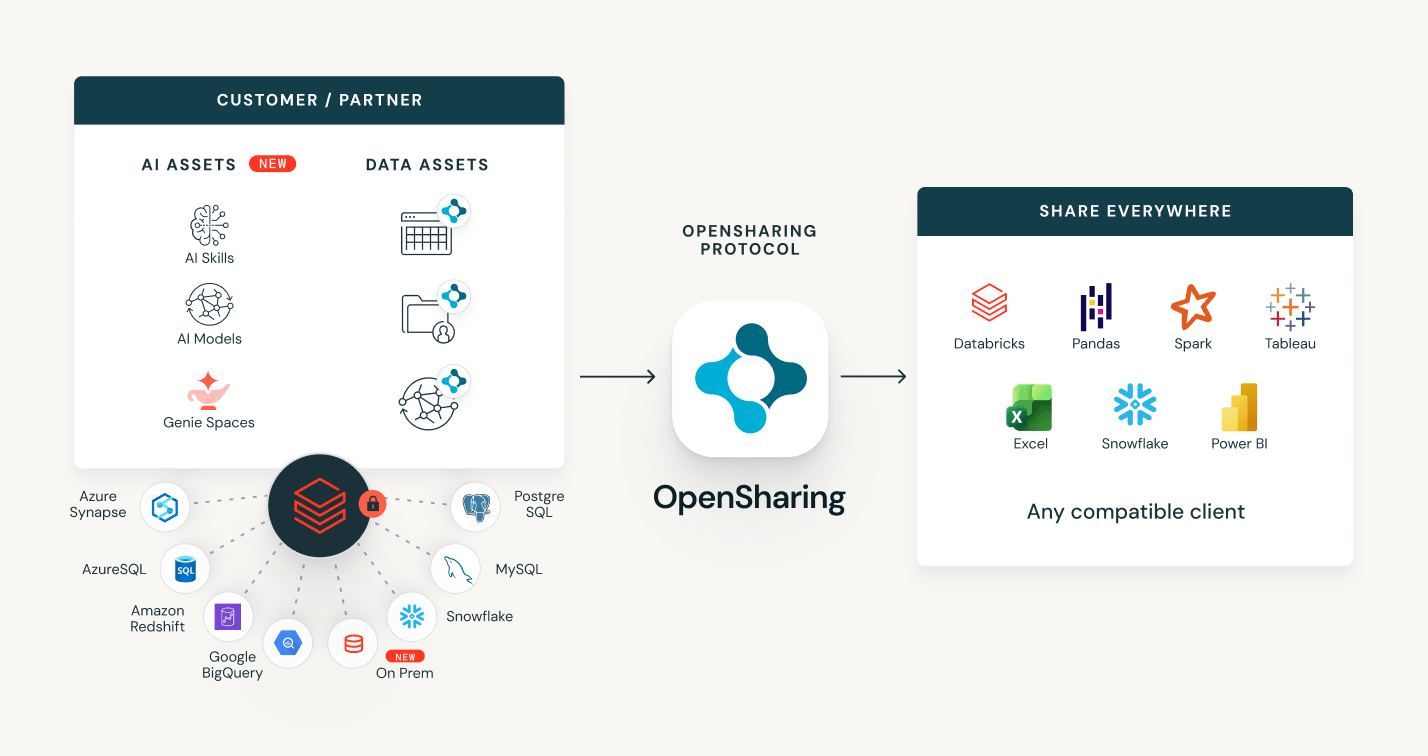
OpenSharing extends Delta Sharing across three new dimensions:
- AI Asset Sharing: For the first time, there is a standard open protocol for sharing Agent Skills, AI Models, and Genie Agents across organizations. Previously, enterprises had no standard mechanism for this, forcing reliance on costly custom integrations or single-vendor marketplaces. Agent skills are the most requested new asset type, followed by AI models. Providers can share Genie Agents, including their semantic context and business metrics, while controlling exactly what recipients can access: prompt quotas, row export limits, and hidden proprietary instructions.
- On-Premises Connectivity: Organizations that must keep sensitive data on-premises or in private clouds can now connect directly to cloud AI platforms without moving the data. This is a significant unlock: for the first time, on-premises data assets can participate in modern AI pipelines without replication or migration.
- Cross-Cloud and Cross-Platform: OpenSharing now supports the Apache Iceberg REST Catalog API, meaning any Iceberg-compatible client can read OpenSharing shares. Snowflake users can receive shares directly. Providers can also share tables from external catalogs such as Hive Metastore, bringing them into the governed ecosystem without data movement.

Source: Databricks
Matei Zaharia, Co-founder and CTO of Databricks, summarised the vision: "Delta Sharing proved the industry would choose open over locked-in. OpenSharing extends that principle to the full AI stack."
Governance: Unity Catalog End-to-End
Every shared asset, whether a dataset, a model, or a Genie Agent is governed by Unity Catalog. Unity Catalog audits every access event, enforces row- and column-level controls, and ensures compliance policies travel with every shared asset. Recipients do not need to be on Databricks, they query shares directly from their existing tools using standard APIs with OpenID Connect (OIDC) federation for authentication.
Existing Delta Sharing deployments are fully backward compatible. Nothing breaks for current users, OpenSharing adds new asset types and recipients without introducing breaking changes.
Conclusion
OpenSharing is a strategically significant announcement. It solves multiple problems at once: it removes the on-premises barrier that has kept large portions of enterprise data out of modern AI pipelines and it establishes an open standard for AI asset exchange before proprietary alternatives lock the market.
The Linux Foundation backing and broad partner support signal that this is designed to become infrastructure, not a feature. For organizations building on Databricks, OpenSharing is worth watching closely as it reaches broader availability. For those managing heterogeneous stacks with on-premises components, the storage partner integrations may be the most immediately practical capability to explore.
FAQ
OpenSharing is the open, vendor-neutral protocol Databricks announced at the Data + AI Summit in June 2026, now a Linux Foundation project. It is the next evolution of Delta Sharing: where Delta Sharing covered datasets, OpenSharing extends the same protocol to the full AI stack, from raw data to Agent Skills, AI Models and Genie Agents, governed end-to-end by Unity Catalog.
Delta Sharing, introduced in 2021, was the first open protocol for secure data sharing across platforms and became the industry's most widely adopted standard. OpenSharing keeps that foundation and extends it in three directions: sharing of AI assets, on-premises connectivity, and broader cross-cloud and cross-platform reach. In our view it is the natural evolution of the Delta Sharing foundations we already build on Unity Catalog.
OpenSharing introduces a standard open protocol for sharing Agent Skills, AI Models and Genie Agents across organizations, alongside datasets and unstructured data. Agent skills are the most requested new asset type, followed by AI models. Before OpenSharing there was no standard mechanism for this, so enterprises had to rely on costly custom integrations or single-vendor marketplaces.
Yes. Providers can share Genie Agents including their semantic context and business metrics, while controlling exactly what recipients can access through prompt quotas, row export limits and hidden proprietary instructions. This is the shift we find most interesting: you expose the analytical value of your data through a governed AI interface, without handing over the underlying datasets or your business logic.
Organizations that must keep sensitive data on-premises or in a private cloud can now connect directly to cloud AI platforms without moving that data. We see this as a significant unlock: for the first time on-premises data assets can participate in modern AI pipelines without replication or migration. For heterogeneous stacks, the storage partner integrations are often the most immediately practical capability to explore.
Yes. OpenSharing supports the Apache Iceberg REST Catalog API, so any Iceberg-compatible client can read OpenSharing shares and Snowflake users can receive shares directly. Providers can also share tables from external catalogs such as Hive Metastore, bringing them into the governed ecosystem without data movement. That cross-platform reach is what keeps providers out of vendor lock-in.
Every shared asset, whether a dataset, a model or a Genie Agent, is governed by Unity Catalog. Unity Catalog audits every access event, enforces row- and column-level controls, and ensures compliance policies travel with each shared asset. Authentication for external recipients runs through standard APIs with OpenID Connect (OIDC) federation, so governance stays intact across every organizational boundary.
No. Recipients do not need to be on Databricks. They query shares directly from the tools they already use, through standard APIs with OpenID Connect (OIDC) federation for authentication. Delta Sharing already reached recipients on Databricks, Apache Spark, Oracle, Power BI, Tableau and Snowflake, and OpenSharing widens that reach further through Iceberg-compatible clients.
Yes. Existing Delta Sharing deployments are fully backward compatible. Nothing breaks for current users: OpenSharing adds new asset types and new recipients without introducing breaking changes. In the Unity Catalog-based data platforms we have built over the last few years, Delta Sharing is already in place, and OpenSharing builds on exactly that foundation rather than replacing it.
It removes two barriers at once. The on-premises barrier that kept large parts of enterprise data out of modern AI pipelines disappears, and an open standard for AI asset exchange is established before proprietary alternatives lock the market. With Linux Foundation backing and broad partner support, this is designed to become infrastructure rather than a feature, which makes it a strategic planning item.
This is most relevant for data platform leads, CDOs and data product owners at organizations running Databricks with Unity Catalog, especially those already sharing data across business units, with partners or with customers, and now asking how AI assets fit into that picture. We are following the preview closely, so reach out us for a tailored view on what it means for your platform.
We have been enabling Delta Sharing as part of Unity Catalog-based data platforms for several years, and OpenSharing is the natural next step on that foundation. We recommend starting with a review of your current sharing setup, your governance model and your data product ambitions. Wondering what this means for your data platform or data product strategy? Let's talk.